


“Vehicle prices will remain high due to the increase in the dollar rate. Additionally, we have imposed some taxes, as we cannot afford to face another crisis if there is a sudden surge in demand for vehicles,” – President.
The Sri Lankan government has published Gazette Notification No. 2421/41, signed by President Anura Kumara Dissanayake in his capacity as the Minister of Finance, Planning, and Economic Development, specifying the new luxury tax rates on private motor vehicles imported into the country effective from today (February 1, 2025).
The full Gazette Notification, detailing the applicable luxury tax rates under the Combined Classification Code, is outlined below.
“By virtue of the powers vested in me under Section 10 A of the Customs Ordinance (Chapter 235) as amended by Act, No. 83 of 1988, I, Anura Kumara Dissanayake, Minister of Finance, Planning and Economic Development of the Democratic Socialist Republic of Sri Lanka, do by this order levy on imported goods specified in the Schedule hereto, a surcharge at the rate of 50% on applicable Customs Import Duty, both General and Preferential basis, with effect from February 01, 2025 for a period of one year,” the notice said.
The general customs duty is about 20 percent for vehicles which would go up 10 percent to 30 percent.
Download the Customs 2422-43-customs-duty-surcharge-EN from here
A gazette was also issued detailing taxes for electric vehicles.
Download the EV tax gazette from 2421-42-Electric-Vehicle-tax-XID-EN here.
A new luxury tax gazette has also been issued, specifying a level of 5 to 6 million rupees per vehicle, which is higher than the earlier level. A higher threshold allows lower cost vehicles to escape the tax.
However from 2019 to now, the exchange rate has also depreciated from around 184 to 300 to the US dollar.
Download the 2421-41-Luxury-tax-LMVT-Jan31-EN here.
Sri Lanka banned the import of over 3000 goods in 2020 after the central bank printed money to target an ‘output gap’ through direct and open market operations. Potential output was based econometric technical advice from the International Monetary Fund.
Sri Lanka has restrictions on imports including through taxes and exchange controls because the central bank has flawed operating framework which trigger forex shortages from anchor conflicts.
The currency is then depreciated under under a de facto policy involving ‘interest rate as the last line of defence’ which the IMF pushes as the’ exchange rate as the first line of defence’.
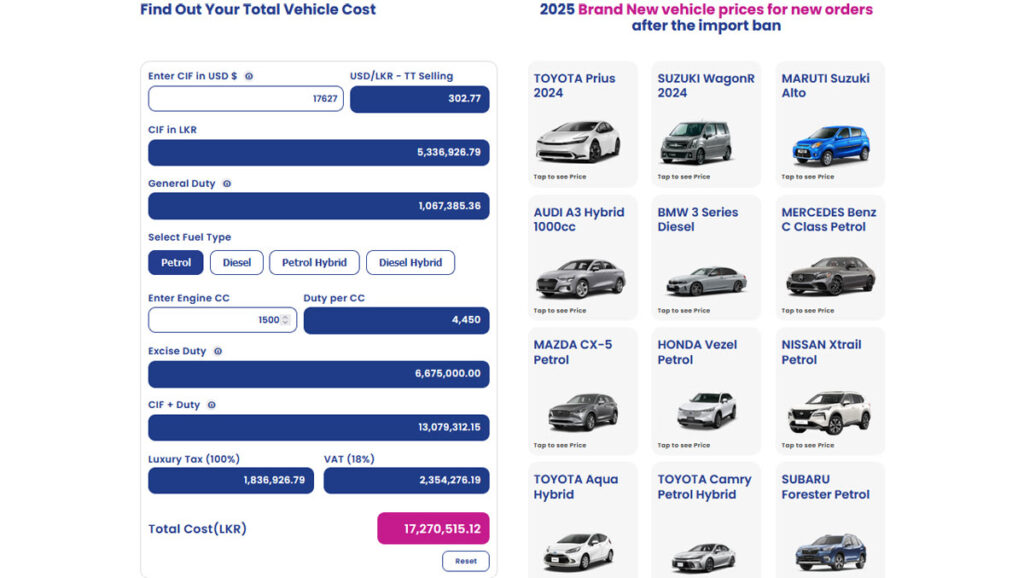
Capital Alliance, a Colombo-based investment banking group has produced an online tax calculator as a rough guide for their clients to estimate the import cost of a car, based on publicly available tax information.
A prospective car buyer looking to import a car has to key in the CIF prices of a car, the exchange rate, engine capacity, luxury tax (if applicable) and similar relevant information in the web-page.
Link to webpage here.
When the car is petrol, diesel or electric can also be selected.
The web page also has pre-calculated taxes for some popular vehicle models, from the Maruti-Suzuki to a Honda Vezel which can be clicked.
But Sri Lanka on Friday night issued a gazette slapping a 50 percent import duty surcharge was slapped on motor vehicles.
The general duty was around 20 percent up to January 30, indicating that CID would go up to around 30 percent, after the surcharge.
Two other gazettes were issued detailing luxury taxes and taxes on electric vehicles.
Vehicles could attract port charges, clearing costs and also dealer margins. (economynext)
Sri Lanka tax payer ID needed to register imported motor vehicles!
Individuals with a Sri Lanka tax payer identification number will be allowed to register a vehicle, the Finance Ministry said after lifting an import ban and hiking taxes.
Vehicles cannot be imported through tax free permits already issued for state workers.
“The importer or buyer shall submit an Affidavit including the Tax Payer Identification Number issued by the Department of Inland Revenue… for the registration of motor vehicles,” a statement from the Finance Ministry said.